

Fascia: Their Role in Massage Therapy and Myofascial Release
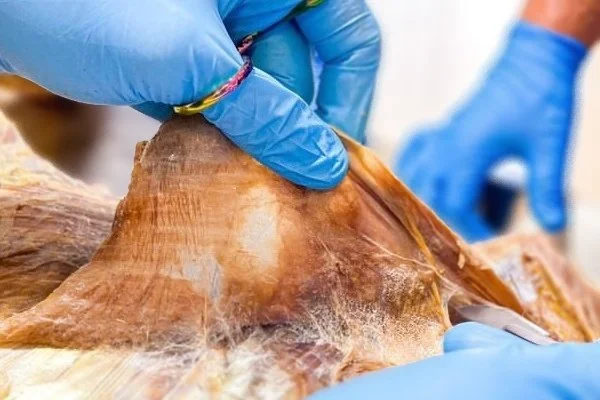
Image courtesy of ABMP (Associated Bodywork & Massage Professionals, 2022)
“Ahh! My shoulders are tight and painful!” This seems to be the go-to complaint many people have when they seek a massage; perhaps, you’re one of them. When you book yourself a massage appointment and get worked on, you may be thinking that your massage therapist is loosening that muscle that is responsible for all that discomfort you’ve been experiencing. Of course, muscles can play their part in your discomfort, but it is rarely the whole picture. What may be causing most of your discomfort could be attributed to your fascia (I touched on fascia very briefly in a past blog post). So, what is fascia, and their role in massage therapy and myofascial release?
The fascia is a tissue that surrounds everything from organs, muscles, bones, and nerve fibers. The whole fascial system helps our form be a bipedal human rather than a glob of all the things that constitute us. From the fact that they support our posture, you can make a logical guess that it is not easy to manipulate. In past experiments to create permanent tissue change, researchers have found that you either must give an extremely forceful stretch that will obviously tear muscle fibers, or stretch for an unreasonable amount of time at a much less intense of a stretch (Schleip, 2003). They both sound ridiculous and are far from what happens in a massage session, but how come we still feel that relief?
This is where the nervous system link comes in! There was a research done to see if tissues would respond to manual treatments in people who are under anesthesia. Interestingly, tissues did not respond as it does under normal circumstances when that neural piece was cut out (Schleip, 1989). Taking pieces of information together, what massage therapists do with our work is not quite forcefully removing “muscle knots”, but more sending signals to your nervous system to release the tension you’re holding. The fascia contains about 3 times more sensory neurons than motor neurons, with a subtype of receptors that support other receptors in reacting to tension and pressure also having connections to autonomic functions (Mitchell, 1977). If you think back to your high school science courses, autonomic nervous system is the one that controls our heartbeat, blood flow, etc; the ones that we don’t have to think, but our bodies do kind of things. This helps make sense how massage may relax those hyper tense spots by activating those sensory neurons, which then may start to affect other functions like helping to lower blood pressure.
The effects of myofascial manipulation were concluded like this by Schleip: “Tissue manipulation → stimulation of mechanoreceptors → central nervous system → tonus change to related skeletal motor units → palpable tissue response (2003)”. That’s a little complicated so I’ll tone it down: a massage technique stimulates the nerves to send signals to the brain, which sends a signal back to that area to relax, and that is when you and I both feel that “knot” release! One thing to note here is that there are receptors that respond to sustained pressure and those that respond to fast pressure changes (Schleip, 2003). This could imply that almost any type of massage can create changes in the fascia and the muscles.
Massage therapists typically use a technique called myofascial release to work on the fascia. The technique involves slow, sustained pressure applied to an area, and it can be deep pressure as well as lighter pressure. If the fascia reacts to rapid as well as slow pressure, maybe it doesn’t have to be myofascial release to release the tension in the fascia. However, there have been other benefits reported to the use of myofascial release techniques in a recent meta-analysis. Potential benefits include relieving chronic pain, helping people recover from sports injuries, reducing headaches, and many more (Lv, 2024). The usage of myofascial release technique is still quite relevant as a form of working on the fascia due to having all these positive effects.
The topic of fascia cannot be separated when we speak of massage; when massage therapists perform their massage on you, the fascia is being manipulated and never just the muscles. With research seemingly pointing to the importance of fascia in you feeling that “muscle knot” releasing, it makes it important that us massage therapists are effectively working on the fascia. However, it may not have to be myofascial release technique specifically, though there are other benefits to using that specific technique. Also, it is worth noting that most of the research I cited here are relatively old and there may be newer information available. My style of massage uses a lot of myofascial release technique, and though I cannot fully say it is the most effective way to work on the fascia, it has other benefits while still working on the fascia. It was a lot of information (for me too lol), so maybe it’ll serve both of us better if you just come and experience your fascia being manipulated.
Thanks for reading!
References:
Associated Bodywork & Massage Professionals. (2022). Finding Fascia Through Human Dissection [Photograph]. ABMP. https://www.abmp.com/updates/blog-posts/finding-fascia-through-human-dissection
Lv Y, Yin Y. A Review of the Application of Myofascial Release Therapy in the Treatment of Diseases. J Multidiscip Healthc. 2024 Sep 26;17:4507-4517. doi: 10.2147/JMDH.S481706. PMID: 39351042; PMCID: PMC11441305.
Mitchell JH, Schmidt RF. (1977) Cardiovascular reflex control by afferent fibers from skeletal muscle receptors. In: Shepherd JT et al. (eds). Handbook of Physiology, Sect. 2, Vol. III, Part 2. American Physiological Society Bethesda, MA, pp 623–658.
Schleip R. (1989). A new explanation of the effect of Rolfing. Rolf Lines, 15(1): 18–20.
Schleip, R. (2003). Fascial plasticity – a new neurobiological explanation: Part 1. Journal of Bodywork and Movement Therapies, 7(1), 11–19. https://doi.org/10.1016/s1360-8592(02)00067-0

Yuzuki Needham, Licensed Massage Therapist
Colorado License Number Mt.0025760
I’m the owner of Reset Massage & Bodywork and I provide movement incorporated therapeutic massage to help active adults recover and move better. I am a graduate of Denver Integrative Massage School and hold an active Colorado massage license (Mt.0025760). I continually update my skills and knowledge through taking continuing education courses from the likes of Associated Bodywork & Massage Professionals, Eric Dalton’s Myofascial Alignment Techniques, and Whitney Lowe’s Orthopedic Medical Massage. I also hold a Bachelor of Arts with a major in Psychology and a minor in Cognitive and Behavioral Neuroscience from University of Colorado Denver.